Sunday, September 6, 2015

MUQTADA AL-SADR AND THE FALL OF IRAQ by PATRICK COBURN

Written at a time when the Shia resistance was consolidating the political landscape and already making Iraq a major Iranian sphere of influence came the military resistance led by Muqtada Al-Sadr which set US forces into a retreat , thus making US planners realise the Military domination of Iraq was already in an unstoppable countdown.

The reason of success for the Shia was that they formed an alternative Government first and then the object of the Political and military resistance was to defeat the Occupation and put the Alternative Government in place.

Patrick Coburn was the first writer of a Book about the young leader Muqtada , this makes it a bit of a , albeit an informed one , rushed job on a fast moving and evolving scene. This review by James Denselow points out some of the weaker construction of the Book.
 "Patrick Cockburn's friend and colleague Robert Fisk once wrote that he saw journalism as `writing the first draft of history'. On the sleeve of Cockburn's latest book on Iraq it states that `this is the first book about Muqtada al-Sadr, the most important political figure in post-occupation Iraq'. The question that arises is did Cockburn have enough material to write a biography of al-Sadr? Or did the gap in knowledge and frenzy in politics surrounding the Iraqi cleric prompt the publishers into pushing Cockburn into writing a first draft instead?

Reading the book one discovers that it is indeed the later. But Cockburn knows Iraq well enough to write a decent background account of the rise of Shia in Iraq that will appeal to those who are unsatisfied with the US official rendering of Muqtada as little more than a renegade. It reads as a coherent narrative heavily laced with journalistic anecdotal evidence to provide a very readable background to one of the `new Iraq's' new politician's.

The difficulty is access to Muqtada himself. Cockburn's experience in the first chapter, where he just manages to avoid death at the hands of the Sadrists, highlights the danger in getting close to him. So despite reading an entire book nominally about him, the reader is still left wondering who the man behind the evolving myth actually is.

Cockburn covers a lot of ground very quickly in the book. He starts with a twelve page introduction to `the Shi'a of Iraq' and races on through the Iran-Iraq War, the subsequent Shia uprising and the various trials and tribulations of Muqtada's family as they walk the deadly tightrope of the Saddam era. The cornerstone of Cockburn's book is to connect the history of the Shia with its relevance today - which is an implicit critique of those who would enter Iraq from an ahistorical perspective. At one point he explains how post-invasion the Grand Ayatollah Ali al-Sistani banned chess. Why? because `Yazid was playing chess in his palace in Damascus when the head of Imam Hussein was brought to him' (p.26).

The key focus is on the rise of Muqtada. Cockburn explains his emergence as the response to a vacuum created by an ill-conceived and unimaginative US invasion. The collapse of the Saddam Hussein regime and the inability of the US to replace it allowed the Shia clergy and its mosques, repressed for so long under Saddam, to spring up and take control of vast swathes of local politics. It was the failures of the invasion plan, combined with earlier failures in the West's policy towards Iraq, that set the scene for an environment into which Muqtada would emerge. Cockburn cites the mass impoverishment of Iraqis as an essential precondition for the `swift rise of Muhammad Sadiq al-Sadr in the early 1990s and his son Muqtada after 2003' (p.107).

Cockburn's short chapters covering lengthy historical events argue that Muqtada was a natural and predictable consequence of the fall of Iraq. The US occupation of Iraq and the initial top-down `Coalition Provisional Authority' (CPA) run by Paul Bremer, could never accept this existence of a contesting authority figure. That Sadr's support was based on a grassroots legitimacy born from the split blood of his own family clashed with CPA's bunkered Green Zone mentality that somehow Washington staffers could build the new Iraq as they liked.

Cockburn is correct when he points out that "the Shia were not, after all, trying to break up Iraq, but get their fair share of power within it" (p.82). Ironically, considering that America considered Iraq's sovereign unity a matter of critical importance, the CPA supported the Iranian backed SCIRI and exiled based Dawa party over a homegrown Sadrist alliance. Muqtada even harnessed what was left of battered Iraqi nationalism and in 2005 offered support to the besieged insurgents in Fallujah.

There is little doubt about the importance of Muqtada al Sadr in the deeply fragmented political landscape of modern Iraq. Cockburn's work is a testimony to this importance, yet you feel that much more will and can be written on one of Iraq's most elusive figures."
Like a revolution in Iran , we find that the Al-Sadr senior leaders under Saddam the " Shia now possessed a clergy and religious organisation that was separate from the State.Potentially it could provide an alternative leadership for the Shia. The death of Al-Sadr Senior meant that the younger Al-Sadr could take this "organisation" in a society that had " no central government in many centuries...explains the strength of non-state agencies."

We also find that the massacre of the communists when Saddam came to power was also accompanied to the slaughter of shias in government and civil service positions whilst the nationalisation of the Baathist regime took business away from shias and into mainly sunni led government.

In this interview Patrick Coburn gives more insight into Muqtada and Iraqi affairs before the pullout.


This article from Counterpunch sees Coburn giving his assessement on the retirement from politics by Al-Sadr in 2014



Saturday, September 5, 2015

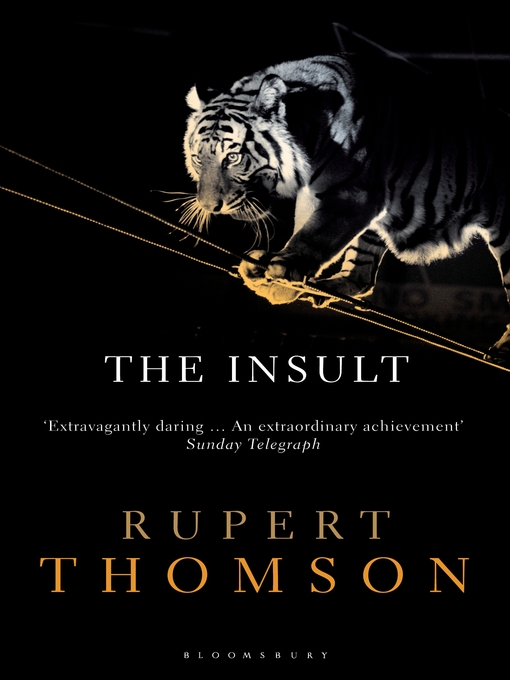
THE INSULT by RUPERT THOMSON

Rupert Thomson claims in an Interview when he looks back at his body of work he cant even remember writing some of his Books , which tallies with my recollection of reading this Book , i know i did but i cant remember doing so or even recall any meaningful part of it.
I wonder if this is a reflection of the type of Books he writes or if he has sublimely taken the reader into the mind of a Character himself that cannot remember his life and experiences.
In this context this review by Ryan Chapman in Goodreads may be worth a mention in full , though it has to be said to be it is a minority opinion.

"I'd heard such good things about Rupert Thompson. I might try another book down the road, but this one was uniquely terrible, I couldn't even finish it. From the unoriginal, solipsistic narrator to the meandering pace and dearth of any suspense or momentum, I couldn't help but think of the author sitting down every day and arbitrarily picking something new for his protagonist to do. ("Today I'll have him order a pastry!" ... "Today he should meet yet another person who's unexplainably friendly to him even though he's a dick toward everyone!")

If anything, this reminded me of Haruki Murakami, where the entire world happens to the male protagonist, in which he expends minimal effort to woo women, make friends, and embroil himself in vague mysteries. I can only take so many books with bored, listless middle-class guys (who somehow don't need to work a day job) narrating to the reader their peregrinations around the city.

I'm sure the myriad strands of the plot come together, but the central conceit is so weak I couldn't bring myself to care. Also, there are dozens of gaps in logic regarding when Blom can or cannot see (the rules Thompson creates for this only seem to apply when he doesn't feel like describing anything visual). An apt title for the book, indeed."
In this interview Rupert describes a later Book and some of his processes.Including a very profound definition that Novels can teach compassion by making one life on another person or society.


Friday, September 4, 2015

THE FIGHT by NORMAN MAILER

One of the best pieces of sports reportage stems from an original and established genre of deep penetrating psychological workings devised by a generation of writers of which Mailer was a major founding contributor.

"D’Amato the boxing trainer and Doctorow the novelist share the same conception of professionalism, and both believe Mailer meets it. D’Amato, who describes Mailer as “someone who was curious not only about boxing but also about people’s minds,”"
In the Book Mailer becomes an almost spectral presence in a tight scene that comes close to a prose fly on the wall type treatise on the moods , feelings and sensory biography of the participants.

As the reviews point out this style can be seen as the Author giving himself the centre stage as much as the participants , but they miss the point that in order to "be with them" he has to adopt the persona of being and moved with them in very close physical and emotional ways.

The video below gives a brief reading from the Book by Alec Baldwin


Monday, August 31, 2015

CAT'S CRADLE by KURT VONNEGUT

Written just after the dramatics of the Cuban Missile Crisis this cynical yet homely satire investigates the absurdity of the ideologies of the scientific age which could yield to a mass wipeout now that Vonneguts world had acquired the technology to do just that.

Vonneguts style is to write as he would speak to his hometown audience which gives it a humourous immediacy.

This review gives a good overview of some of the themes of the Novel which are still appealing to the youth which was born many decades after the Book came out


But last word goes to Kurt Vonnegut himself giving the background of the Novel and what the times meant to his generation in which Technology and Concepts , as well as Human Leader had the ability to be Tyrants of the age.As he says at the 3min20secs mark "I was a great believer in Truth , scientific Truth , until Turth was dropped on Hiroshima."


Saturday, August 29, 2015

THE SECOND SEX by SIMONE DE BEAUVOIR

This work was published in 1949 and has a place in the positioning of Womans Issues on Womans terms from that time on.For that it deserves its status as a landmark Book that put Half of Humanity on the map of Social and Political Welfare.

You can get a brief overview of the structure of the Work in this link.

Some of the Scholarship is impressive in a way that makes one admire someone who has managed to produce a corpus almost single-handedly thus inspiring a whole generation of academic researchers to put meat and bones on a vast conception.

The high praise though has to be counter-balanced by quite fundamental flaws in structure and conclusions which , if this work was a building , would not get the necessary safety certificates to make it a viable place for habitation.

The first is in the cultural and colonial assumptions which make this work a very Euro-Centric vision with the implied theme that only Europe or the West has the answers and progress is to be judged in how Europeanised ( the more palatable euphemism being "Westernised") Non-European Societies can become.The very few Examples from Africa/Islamic World , mostly French Occupied Algeria are given a very negative , almost dismissive , short-shrift.Mostly her objections to Polygamy which she implies is very Common though it is quite rare in the Algerian/Muslim World.An odd objection to dismiss a whole religion and continent considering she was also involved in a "Morganistic" relationship at the time sharing the affections of Sartre with up to four Woman simultaneously.She also seems to have an almost pathologically negative attitude to the concept of Family on the sole evidence that she did not always get along with her Mother.Then there is the dearth of any examples from South America , Asia or even Slavic case studies which hardly make the Work conducive to establishing an Universal as opposed to a Highly Western European template for Womanhood.

Another major anomaly is her citing of quotes from Fiction Novels ( again mostly Western European ones) with the same weighting as one would give scientifically based academic peer reviewed case study analysis.A flaw that is entirely understandable as it is her Work that made this kind of detailed study of the field of gender issues whilst she could not turn to input that was not there before.Despite this valid consideration her methodology has to be seen as critically flawed in every sense of the word.

Her work has inspired many students and academics to delve into the issue of feminism and gender as this article by one of  the brightest , if one can comprehend what she is saying , is Judith Butler.

In the video below we have a lecture which clarifies , or not , the themes of the Book.


Ultimately Beauvoir asks the question of not what does it mean to be a Woman , but what does it mean to be a Western European Woman , which means the answer will only be as good as the question , which in this case cannot lead to a Universal Answer but only a template which will not be applicable to Non-European Cultures and Values , if  , indeed, the answer even matches the Questions to Europeans in todays Social and Employment Corporate marketplace.

Saturday, August 15, 2015

TUTU : VOICE OF THE VOICELESS by SHIRLEY DU BOULAY

Written before apartheid was finally defeated in the late 80s/early 90s about an incredible individual who had won the Nobel Prize for Peace when it was still a credible trophy for genuine strugglers for peace and reconciliation, this book has a tense element of whether apartheid will ever be overcome in the lifetimes of Tutu and the Author herself.

This review captures the tensions of not knowing at the time quite well

"Du Boulay shares in the biography that Tutu proclaims with great faith that apartheid cannot stand forever, that God is on the side of justice and will prevail. However, Tutu must certainly have wondered at the time if such change would come in his lifetime."
The comment in the Amazon entry for the Book by Ellie Gunderson is well worth reading.

 What I enjoyed most about Shirley DuBoulay's biography of Desmond Tutu was its faithfulness to Tutu's true personality and character, both the positive and the negative characteristics. For example, DuBoulay is willing to admit that Tutu's calling to the priesthood was not especially strong at first; however, by the time he began life as a priest, everyone saw that he had a unique ability to connect to all different types of people. More than most, he was able to place himself in another person's shoes, and constantly tended to his parishioners' every need. DuBoulay also admitted that Tutu was irresponsible with money, and was overly sensitive in that he allowed his feelings to be hurt easily.

On page 102 Tutu convincingly state " Justice is the only basis of true order" based on the spirit , on page 114 of "UBUNTU - the African quality of being a person that is deeper than being a mere Human , but a Spiritual Being also."

In the lecture below Tutu Reconciling Love and how this process was applied to the aftermath of uniting South Africa after the fall of apartheid , he also gives a deeper explanation of Ubuntu from the 24min 40 secs mark.


Friday, August 14, 2015

THE SPANISH CIVIL WAR by PAUL PRESTON


This is the best introduction and east access primer to the context and conduct , as well as historical perspective , of the Spanish Civil War.A concise yet detailed study within a very readable and manageable book of less than four hundred pages.Especially valuable is the essay bibliography to the many thousands of sources , archives , commentaries and books on the war throughout the decades to the present allowing the reader to choose which parts of the conflict they wish to investigate in a deeper way.An outstanding work by the best academic authorities on the War and its aftermath.

As a historian Preston readily admits he is partial on the side of the victims and oppressed against the powerful and the architects of terror.A viewpoint and stance that gives his work more urgency and credibility than would someone trying for a balance that can ultimately get so out of hand that the historian gives the same voice to both , in the case of the Holocaust, to the victims as well as the lighters of the ovens which can lead to a gross distortion of history and its lessons for our and future times.

On page 25 describes some of the errors of the democratically elected Socialist Government is dealing with the earlier tensions prior to the war "Moreover, the PSOE was hobbled by its reliance on a rigid "Dogmatic" and simplistic faith in French marxism , and on page 47 "The Government did not react strongly enough to a spate of Church burning"

This was due to in large measure of the Government not being able to muster enough resources to counter the anarchistic actions of anarchists , actions that put up the back of the traditional forces and reduced the credibility of the Government to control the law and order situation and command its mandate to govern for all of Spanish Society.This meant that , by page 57 we have "Southern Owners had declared War on the republican government by refusing to plant crops .....with land reform in the air the landowners did not feel disposed to invest in their land ", hence blocking land reform on the pretext of defending Church and "traditional" country values from the attacks of Communists.This in turn led to , on page 59 "Republican imprudence meant the catholic practice was attacked rather than block politics doctrine , thereby alienating many ordinary catholics with a republican disposition."

On page 244 we find "The Communist Party was pushed from relative obscurity to the arbiter of Republican Politics due to Soviet aid passing through its channel". In the perverted sectarian politics of the hard left the Communists and Anarchists spent more resources and treasure trying to liquidate each other than trying to preserve the integrity of the Socialist war effort.This was mainly because Stalin was playing a delicate game of trying to appease the Western Powers , placating the Fascists and using exporting his anti-Trotsky campaign beyond Soviet borders knowing full well that the Soviet Union would not be ready to fight a war with any of these powers for a few years yet.

Preston rightly identifies the War as the first battles of the 2nd WW , where fascism tested the will of the International Community and its commitment to democracy and found the confidence , as in many cases support , to continue the aggression into the International Theatre in the 40s.

The Spanish People should have received the support of the International Order , instead they were the victims of a bloody Fascist filling in a sandwich between capitalism and communism.