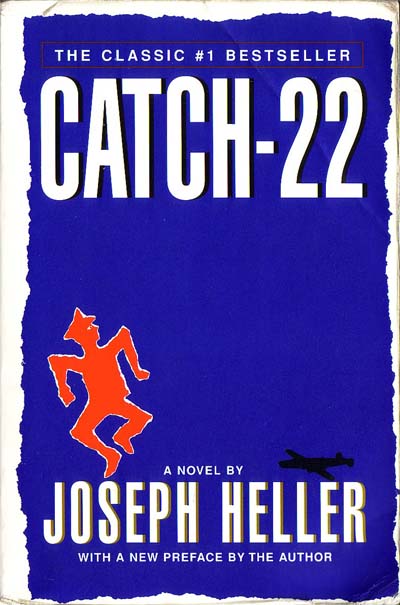
Surprisingly , more than one Person i know has said they have tried to read the Book on many occasions but have struggled to get past the first hundred pages.This is understandable for todays reader as the early part of the Book , breaking new ground at the time , does regurgitate the same joke over and over in ever increasing circles , the effect is a little like watching Monty-Python today seems stilted and laboured even though every comedy satire programme and social stand-up comic we enjoy today would not be here if the major-ground it broke had not cleared the way for them to express themselves comfortable to a mainstream audience.Here are examples this "joke" poping in and out in various guises:
p78 " everyone agreed Clevinger would go far in the academic world.In short , Clevinger was one of those People with lots of intelligence and no brains."
" he was a very serious, very earnest and very conscientious dope."
p95 " always impressed by how unimpressive he was."
If you do struggle with "same joke fatigue" i suggest you skip to Chapter24 titled "Milo".This is the beginning of a serious narrative and the rewarding critique of society and bureaucracy , the Book is no lesser for one having skipped to this chapter, then you can get full value of this classic and appreciate why it consistently nears the top of favourite lists for many readers.
The reward for getting through the Book is also to have the special experience of an uplifting ending which , due to spoiler effects , is so little talked about.Below is an interview with Heller on the 40th anniversary of the ultimate publishing of the work.
Joseph Heller did not rest on the laurels of his debut novel becoming his most popular one over time , here is an interview in which he shares perceptive views on the failings of the usually lauded Athenian Democracy and how we seem to be jumping head first to repeat their catastrophic errors:
In a time of nouveau plotlines from young turk authors , Haven has written an old fashioned book.
The standout of this story is the plot takes place in small town america , not in the coastal metropolises.This gives the angst a real-time feel about a very real america where life is lived in towns and communities of a few thousand to several hundred , a total which represents a much misunderstood and casually maligned significant population of the United States which is becoming an increasing and progressive force countering the neo-establishment "liberal" seaboards which , according to Chris Hedges intimations in the previous video , are rapidly taking on a role of the "progressive" monoliths whereas small town america is taking on a radical role of changing America back to the ways of the old role of strengthening from within without projection of blatant Empire.
Throughout American History a role reversal has been a significant factor , small town america is now where progress is to be found , and as the Book portrays , one of the reasons is that the question of americas soul has already been asked and resolved to some extents , in the same way as , according to Colin Powell the US military had faced and countered the race question in the 50s whilst the rest of US civil society had to wait nearly two decades before they followed suit , whereas the Power belt are in denial , fumbling from one crisis to another as they try to answer the questions of life with military hardware before it inevitably dawns on them to ask and answer the same questions.
In the oscar winning film "The Hurt Locker" the first words , rather like the quotations of Herodotus in "The English Patient" are from Chris Hedges 2002 Book.Herein lies a paradox in the interpretation and therefore conclusions of the work which even the Author has straddled from inception to the changing scenery of War from a highly visual 3-dimensional video game making war into a armchair playstation type game into todays litany and picking over of various "failed" military objectives.
It will be seen this paradoxical view of looking at war as a base necessity for a base desire is not one that Chris Hedges ascribes to at all , but it does have to be pointed out that this Book does give comfort for those who follow this cynical view of Human need.
One question which rightly nags away is in the areas where Chris describes the raging Battles and the requisite inferred "addiction" in the post WW2 zones such as Gaza ; the Balkans ; Iraq is whether , using the addiction to conflict argument the wars in these regions are because the local populace are nourishing a satiation from them or , as a political geographer would likely conclude it is unhealthy outside , external contingency which fuels conflicts which could be readily resolved if left to the devices of the local Peoples without external power block mischief.
"War is a pornography of violence" states the author , describing the essential difference on page 166 we are told Gray wrote " between comradeship and friendship consists , it seems to me, of the heightened awareness of the SELF in friendship and the suppression of self-awareness in comradeship."
The earlier part of the Book deals with the "addiction" of journalists to war-situations rather than the desire of the population in war zones to prolong the process for fear of transfer to a stable non-War existence , the lack of clear differentiation between the two within the Book is where a paradox interpretation is allowed to develop.
As the Book progresses , as also the "case" for war on Iraq was being fought out in the media and political platforms laying partizan siege on the beleaguered civilians Hedges clear anti Iraq War credentials come to the fore in unambiguous terms.At last he realises that modern wars are foisted by the elite entrenched groups on a population that is unwilling to go to Conflict for reasons less than absolute national necessity , so much so , that millions of dollars of private and public finances had to be pumped into the most heavily resourced propaganda campaign in Human History to record even a slight , short-lived , public majority for a war which only a minority of the elite wanted.
Hedges quotes Milan Kundera " the struggle of one man against power.Is the struggle of the memory against forgetting".
Below Chris Hedges set the record unequivocally straight between understanding the "addiction" for war by society and knowing when an unrepresentative elite is trying to take society into the disastrous war for highly suspect and spurious reasons:
Check out especially at the 5 min 5 sec mark his desription of how liberals have lost touch with the working man and like the characters in Dostoevsky Notes from the Underground they aspire to speak the language of the working man whilst falling full square behind the agenda of the corporate elite , all in the name of progress.
Turning attention to how to address ending Conflicts Chris on page 130 sees much value in the type of conflict-resolution processes as the South African Truth and reconciliation Process , deeming it necessary.The reason for this is set on page 133 " the lack of closure tortures and deforms those who wait for an answer....it must be rectified if healing is to take place.".This commission processes are essential because they allow macro and individual victims of War to come to terms with what has happened and to begin the collective endeavour to heal the pain and cure the wounds in order to rectify the past in order to be able to plot a better future.
Admonishing those bitter-enders that still clamour to bring about a war using false propaganda and scaremongering tactics we see on page 146 " It is hard , neigh impossible, to fight a war if the cause is viewed as Bankrupt".The result of the increasing desperate propagation's for continuation of unpopular wars is " the notion that one fact is as good as the next" becomes " one of the most disturbing consequences of War".We can be laid by degrees and extremes of wanting War in order to "aid" the eradication of cultural practices , so we now have some advocating Nato troops being in Afghanistan because it may do the Womanfolk their good , without explaining how fully armed Nato soldiers are to be considered a positive role model for the betterment of female liberation any more so than soldiers of the Armies of Alexander the Great can be considered a worthy intervention for womanhood in the cities they sacked in the same areas 3 millennium ago, rather than the prevention of genocide , which is one of the few cases of war Hedges is prepared to countenance.
The last , and not least , concern is the damage done to the foreign soldier on the ground in a zone in which the hearts and minds of the local population have not been remotely won.On page 162 we get the observation we see in increasing veracity at home " War...probably worse is the psychiatric and spiritual toll" , that is of those poor combatants who return from a tour of duty without any physical wounds." In the 1973 war a third of all Israeli casualties were due to psychiatric causes"
This is a beautifully written and highly evocative tale from the time of the Stalin purges , which Solzhenitsyn mockingly cited as being considered eventworthy because they targeted party cadres who were quite partial to overlook the earlier ones which were suffered by the populace at large , of the early 30s to the great siege of Leningrad during WW2.
This is a Human story told from the point of view of the innocent sufferers of the excesses of all the ideologies clashing at the time.A rich story putting flesh and bones to the astonishingly unfathomable numbers of victims of organised systematic horror.
The narrator on page 98-99 develops a nice handy motto " Lesson number one: expect nothing and nothing will surprise you : But here i am and here i am surprised" and "Lesson number two: regret is a waste of breadth and time." , survival was all.
Here Gillian gives a synopsis of what her tale is all about:
Antonia Fraser was the partner of the late genius playwright Harold Pinter ,as well as the highly talented daughter of Lord Pakenham , more commonly known as Lord Longford.
This biography is of an excellent order , relying on well researched facts allied to a knowledge of the inner workings of elite society and social movements alike.
A very startling observation , shared by many non-dogmatic historians today , is that the French Revolution was a middle to upper class revolt against the pace of distribution of wealth and privileges from the Centre to the neo-estate.
A more accurate reading of the continuum of historical events from the end of the reign of the Sun King until the aftermath of the rise of Napoleon is that France was not in a position to wage expansive military campaigns against their neighbours in order to increase wealth for the ever burgeoning middle class.Between the paying of debts to the creditors ( 41% of GDP) and the expense of the Royal Estate ( 7% of GDP) nearly half of the French economy at the time disappeared into the black hole of repayments , the cost of the Royal Estate is not particularly excessive when you compare that the Mogul Court a century earlier would spend the extent of about 28% of Indias GDP on itself , but the crucial difference was the Mogul court has surplus funds whilst France , the loser in the development of Empire was in debt to an extent which would match many African third world nations today.France was in a constrained zone between being too weak to forcefully acquire the wealth of neighbours and being just about strong enough to defend itself from encroachment from neighbouring empires.The net result was an internal implosion leading to civil revolt and collapse of the Royals which took about an year to be stabilised by the middle classes from the hiatus of the romantic revolutionaries.
The most concerning aspect of the period is that France did manage to effect a change over to becoming an expansionist power and reverted back to military domination of the region to cure domestic economic shortcomings.The poor were always out of the equation of this process and hardly featured in any central aspect of the period.Even the famous march of the poor to Versailles which has been romanticised into some great movement of the working class to bring down the elite was actually a march to plead with the King to open up the bakeries which had ceased to function in the confusion of the situation in Paris so that they could have something to eat.As soon as the King gave the order for the granaries to be opened they dispersed out of the scene.
One major shortcoming in the otherwise excellent high standards of factual discretion Antonia employs is when she completely abandons her exemplary thresholds in the matter of Antoinette highly unlikely affair with Fersen.As has been correctly pointed out by historians there were so many courtiers in attendance at any time word of an affair would have been known to several individuals if it had ever occurred.Other evidence to counter the claim is that not even the enemies of Antoinette or foreign intervention conspiracy theorists at the time made use of a charge which would have served their interests very well.But the best evidence to counter is provided by Fraser herself , she states that the physical health of the extremely ill and drained Antoinette at the time was such that a non platonic relationship would almost have certainly led to her death.
This brilliant set of short stories gives a perfect display of the taut , incisive , precise style developed and championed by Conrad.Like Conan Doyle and Jack London he manages to get away from the flowery language of earlier writers into the mechanical industrious language of the times they lived in whilst still retaining a pumping Human Core at the centre of what they say.
This video gives an introduction of the early life of Conrad:
An unofficial biography is always going to have a degree of uncomplimentary or barely comfortable facts and exposures about the subject in hand , especially as one which is hard to pin down and controversial as Germaine Greer in non-cooperative , if not hostile mood.
But that should never be an excuse to not give credit where it is due to the subject in question , sometimes for other than entirely sincere reasons.It is what is not said about Germaine by the author which makes this work a disappointment almost to the point of pathologically personally vindictive degree.Insincerity does not make for impartiality and balance.
One especially , amongst many others , example of insincerity is an attempt to pass off Germaine as a secondary level scholar in academic circles when she was one of only about half a dozen intellectuals to secure a Pee-Aitch-Dee for work on Shakespeare between the end of the 2nd World War and the beginning of the 70's.This was because it was thought so much has been studies of the Great Bard that was very little scope for any fresh thinking to be brought to bear in this highly saturated subject.Allied with the instance of declaring she was weak in French , only yo mention in passing that she had a very high accomplished academic level of French later on , without any intervening qualifications for the earlier statement.
Despite this , any biography on Greer is worthwhile as one is bound to unearth facts which will give the reader an understanding of the thoughts and feeling of the times in which she participated.
On page 11 we get the motto which makes Germaine tick and provided the motivation that got her from Australia to having the Phd from Cambridge at the time around her 30th birthday , "Facta Non Verba" , Deeds not Words.
Also worth noting is she tried to commit suicide in the second year of her University and had her first abortion , allegedly being dropped "cold" by Two Men.According to page 42 she was also raped.
By page 52 we are already into an early realisation by Greer that "standardisation of commodities to the standardisation of Persons" society that was developing as she came of age , a theme she was to take up for "The Female Eunuch".
One very important consideration is that Greer was involved in Sexual Liberation and not ideological Feminism per se.This is where a lot of misunderstanding came about when she was seen to be at a point of divergence with the hardcore feminist movement in her later works.
On page 280 we discover the "First wave of feminism established a beachhead , the second emphasised legal empowerment , the 3rd wave is about exercising those rights." and on page 284 we come to bit of advice that Christine herself would well to take up " avoid trashing other Woman , be inclusive , advance (consistently on multiple fronts ; and write and remember your history."
Germaine messed up her insides so badly she could not have children , and her appearances on TV shows which conflate exposure for substance and triviality for credibility have somewhat cheapened the force of any more broad statements she still has to make as feminism tries to find if it has genuinely liberated Woman or just made them into surrogate Men in an ostensibly mans World.
But , to her credit , she is a strong advocate for the rights of the Aboriginies and also a Patron for the Palestine Solidarity Campaign in the UK at a time when some highly questionable strands of the feminist movement are showing support for the Western Military Occupations in Iraq and Afghanistan on the bizarre rationale that gun-totting males allied with cluster bombing male dominated Air Forces are somehow going to do the local Womanfolk some much needed good.